
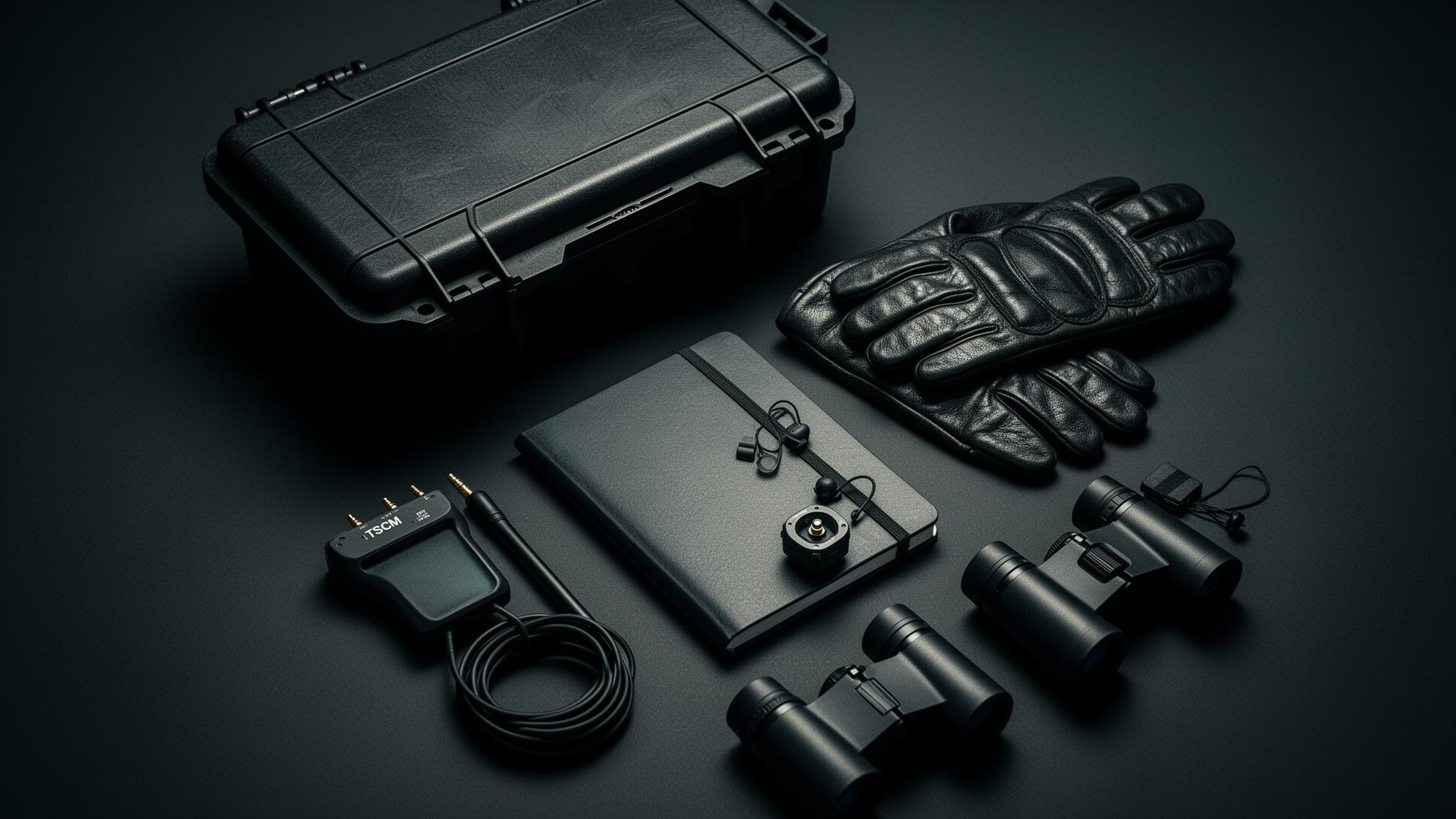
Specialist Operations
Specialist security operations are the capabilities outside the scope of generic security contractors: secure logistics for pharmaceuticals, fine art, and sensitive documents under GDP and chain-of-custody standards; critical-infrastructure protection for sites whose failure has societal consequences; and IFAK supply configured for specific deployment environments. Each capability is delivered by specialists with current operational experience, not generalists.
Specialist operations is the reason specialist security exists. The capabilities here — bug sweeps, escorted high-value cargo, infrastructure hardening, field-ready trauma kits — are the ones that mass-market firms quietly subcontract or refuse altogether.
TSCM (Technical Surveillance Counter-Measures) sweeps boardrooms, residences, and vehicles for active and passive eavesdropping devices, paired with a written report and a remediation plan.
Secure logistics moves pharma, fine art, and jewellery under documented chain-of-custody, with vetted drivers and route engineering. Critical-infrastructure protection covers physical and procedural hardening for power, water, and telecom sites. IFAK supply ensures field-ready first-aid kits get to the people who actually need them.
- TSCM / Bug Sweep and Counter-Surveillance
- Secure Logistics — High-Value Goods (pharma, art, jewellery)
- Critical-Infrastructure Protection (power / water / telecom)
- IFAK / Tactical First-Aid Kit Supply
What specialist operations actually means
Most security firms offer a version of manned guarding, alarm response, and perhaps some close-protection work. Specialist operations is what those firms quietly decline or subcontract when a client asks for something outside that narrow range. The disciplines collected here — secure logistics, critical-infrastructure protection, IFAK supply, and TSCM — require different training pipelines, different equipment, and different risk management frameworks than mainstream guarding. They are not upsells or packaging exercises: they are capabilities that a firm either has or does not have.
The practical consequence of this gap is that organisations facing specialist security requirements often end up with a procurement process that returns no credible vendors, or worse, returns vendors who agree to the scope and then quietly staff it with personnel who are not actually qualified. Mission Support exists to close that gap — not by claiming to do everything, but by carrying a narrow set of specialist capabilities to a genuine professional standard and declining to quote on assignments outside that range.
Across specialist operations, the common thread is accountability. Every assignment produces documented outputs: a TSCM sweep report with an RF log and physical inspection record, a chain-of-custody log for a secure logistics movement, a configuration record for an IFAK supply, a hardening report for an infrastructure protection engagement. These outputs are not gestures — they are the record of what was done, by whom, under what standard, and what was found.
Secure logistics — the capability that matters when the cargo cannot be replaced
Secure logistics covers the physical movement of high-value, sensitive, or legally regulated goods — pharmaceuticals, clinical trial materials, fine art, jewellery, sensitive documents, and cash equivalents — under documented chain-of-custody protocols. This is not armoured courier work in the traditional sense: it is a complete movement discipline covering route engineering, vehicle selection and vetted driver assignment, real-time tracking, pre-delivery verification, and a chain-of-custody record that meets the evidential and compliance standards required by the recipient sector. In the pharmaceutical sector, for example, custody records must satisfy GDP (Good Distribution Practice) requirements and may be subject to regulatory audit; in the art world, courier documentation is part of the provenance record.
Route engineering is where most of the risk is removed before the movement starts. Each transport is planned against the cargo's value, its sensitivity to time and temperature, the threat picture on the route, and the recipient's handover requirements. Vehicles and drivers are matched to that plan, not drawn from a general pool, and the movement is monitored by a security oversight layer that can intervene if the plan is compromised.
The thread connecting secure logistics and critical-infrastructure protection is consequence management: both disciplines exist because the cost of failure is not measured in service complaints but in regulatory liability, reputational exposure, or physical harm. The bar for capability verification is correspondingly higher than in routine security work.
Critical-infrastructure protection — hardening what cannot go down
Critical infrastructure — power generation and distribution, water treatment, telecoms, transport hubs, and financial market infrastructure — is defined by its consequence profile: failure does not produce a business problem but a societal one. The security requirement that follows from this consequence profile is materially different from conventional commercial security. Threats include physical intrusion intended to cause operational disruption, insider threat from authorised personnel, and hybrid attacks that combine physical and cyber vectors.
Physical protection of critical infrastructure sites requires integration across perimeter security, access control, video surveillance, guard force deployment, and detection systems — coordinated to a threat model that reflects the site's classification, its attack surface, and the regulatory framework that governs it (in the Netherlands and EU: NIS2, ATEX where applicable, sector-specific regulation from ACM, NMA, or RDI). The protection programme must be defensible to a regulator, not just functional in the field.
Mission Support's critical-infrastructure protection work covers security programme design and audit, physical hardening recommendations, guard force assessment, and the documentation required to demonstrate compliance to operators, regulators, and insurers. We work as an advisory and assessment layer — or as the operational security provider where a managed guard and response capability is required — and we do not overstate our scope: where a site requires sovereign-level protection, we are explicit about that boundary.
Frequently asked questions
What does secure logistics cover and is it different from standard courier work?+
What does critical-infrastructure protection involve in practice?+
What are IFAK kits and who are they for?+
How does specialist operations relate to the TSCM service listed separately?+
Talk to a specialist about this service
We will respond within one business day. Initial conversations are confidential and without obligation.
Request a Consultation